

Overview
Our R25 program provides NIH-funded (R25)intensive research training and education to five residents annually in otolaryngology-head and neck surgery and to medical students (one per year). We have created an environment that supports the systematic refinement of a physician trainee’s analytical and research skills, and facilitates the potential for a productive research-oriented career in academic medicine. This is accomplished by:
- Selecting individuals with previously demonstrated commitment to biomedical research. For our residents, this includes a commitment to extend their residency training one year beyond the five-year norm. For our medical students, this entails taking a full year away from medical school, usually after MS2 or MS3.
- Sustaining and expanding a departmental culture in which research is an integral part of the mission among the otolaryngology-head and neck surgery (Oto-HNS) faculty, residents and staff.
- Exposing and facilitating research involvement throughout the residency period.
- Teaching teamwork and acceptance of critical and supportive input from peers and mentors.
- Exposing trainees to successful junior faculty and established senior scientist mentors.
- Providing exposure to issues and methodologies at the cutting edge of biomedical fields related to Oto-HNS and communication disorders.
- Instilling concepts of biomedical ethics and the excitement of lifelong questioning as a source for personal growth and career satisfaction.
We also recognize that this is an ongoing process through which we must continually refine the program based on immediate needs and an ongoing evaluation.
Eligibility
Only US citizens or permanent residents are eligible for R25 funding.
How to Apply
Residents: All residents are automatically enrolled in R25-supported research for one year followed by 3 months of institution-supported research.
Medical Students: All medical students interested in the R25 program must complete this intake survey. Upon receipt of your survey response, our staff or program directors will respond to discuss your interests and potential opportunities. Please reply to the survey well in advance of the March 1 application deadline. **Applications for the 2026-27 year are now closed.**
Program Directors
Jenny Stone, PhD stoner@uw.edu
Jay Rubinstein, MD, PhD rubinj@uw.edu
David Horn, MD, Msc dlhorn@uw.edu
Faculty Research Mentors
R25 PROGRAM MENTORSHP – 2026-2027
Research training and education extends throughout otolaryngology-HNS residency and includes medical students. Research mentorship often is a collaborative process, with diverse contributors. We have developed a two-level mentorship structure to ensure its success, following NIH guidelines and requirements, as shown below.
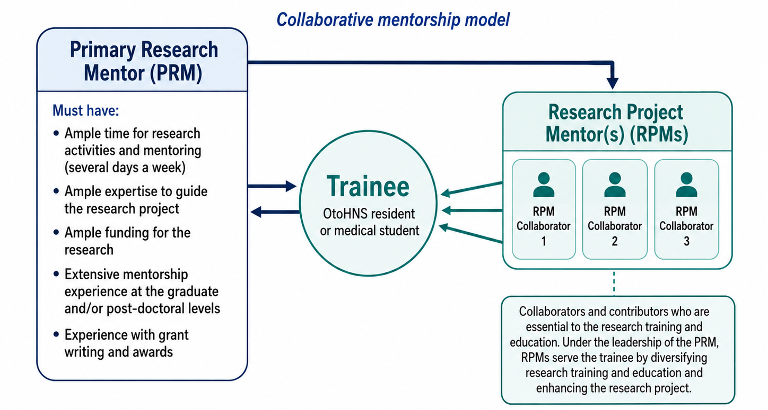
PROGRAM CO-DIRECTORS:
Jennifer Stone, PhD, is a research professor of otolaryngology-HNS. Dr. Stone was the program director of the NIH/NIDCD-funded Research Training in Otolaryngology T32 program and retained a leadership role with the transition to the Clinician-Scientist Research Education and Training in Otolaryngology R25 program in 2024, as a co-principal investigator with Dr. Rubinstein. Dr. Stone studies regeneration of vestibular hair cells and recovery of vestibular function in adult. Dr. Stone has served as primary research mentor for resident trainees Drs. Golub, Lee, Jáuregui, and Tarfa; predoctoral medical student trainees Hicks and Dorssers; and several additional pre- and post-doctoral trainees.
Jay T. Rubinstein, MD, PhD, is a professor of otolaryngology-HNS and bioengineering and is the Virginia Merrill Bloedel Chair of Clinical Hearing Science & Center Director. He serves as a co-principal investigator with Dr. Stone on the NIDCD R25 Clinician-Scientist Research Education and Training in Otolaryngology program. Dr. Rubinstein’s laboratory conducts computational, physiologic, and behavioral studies of cochlear and vestibular implants, as well as investigations of inner ear genetic mutations. Dr. Rubinstein has mentored clinicians, scientists, and clinician–scientists at all career stages. He co-mentored two successful K23 awardees (Drs. Horn and Bhatt) and trainees on our T32 (Drs. Golub and Ryan Carlson).
David Horn, MD, MS, is a professor and vice chair of research in otolaryngology-HNS, with an adjunct appointment in speech and hearing sciences. He is a member of the Center for Clinical and Translational Research at Seattle Children’s. Dr. Horn is the co-investigator on the NIDCD R25 Clinician-Scientist Research Education and Training in Otolaryngology program. His Prosthetic Auditory Development Lab studies auditory development in infants with cochlear implants. Dr. Horn has served as primary research mentor to multiple trainees, including Drs. Dudley, Walker, Noble, and Epstein.
PRIMARY RESEARCH MENTORS WITH FACULTY APPOINTMENTS IN OTOLARYNGOLOGY-HNS:
Waleed Abuzeid, MD, is an associate professor in otolaryngology-HNS (rhinology/skull-based surgery specialist). His research in real-time surgical navigation and AI-supported clinical decision-making facilitates close working relationships with researchers in UW engineering and the tech industry. He is a new primary research mentor for our current medical student, Mr. Harris, and project mentor for Dr. Ruthberg. Both projects use computer vision techniques for improving endoscopic sinus surgery.
Neel K. Bhatt, MD, is an associate professor in otolaryngology-HNS and laryngologist. He was awarded a K08 award to support his research. His primary area of investigation is understanding the neurophysiology of the aging larynx. Dr. Bhatt served as research project mentor for Dr. Jaleel, with primary research mentor Dr. Perkel. They continue this partnership mentoring Drs. Leong and Patterson.
Randy Bly, MD, is an associate professor of otolaryngology-HNS and a pediatric otolaryngologist at Seattle Children’s, and a member of the Research Institute Center for Respiratory Biology and Therapeutics. Dr. Bly applies computer engineering methods to improve surgical planning for organs of smell, taste, hearing, and skull base. He has been/is a research project mentor to Drs. Raju, Konuthula, Pulido, Adidharma and Feng. He will be a primary research mentor for Dr. Ren in 2027-2028.
Yoshiko Kojima, PhD, is a research associate professor in otolaryngology-HNS who, with support from NIH grants, studies compensatory saccades, a part of a central vestibular rehabilitation process that improves visual acuity and suppresses oscillopsia, in non-human primates and in humans.
Bonnie Lau, PhD, is a research assistant professor in otolaryngology-HNS who, with NIH funding, studies auditory brain and perceptual development, with a focus on deaf and hard of hearing and autistic children. She has mentored multiple post-doctoral fellows.
David Perkel, PhD, is a professor in biology and otolaryngology-HNS. He co-directs the UW Auditory Neuroscience Training T32 program for PhD predoctoral and postdoctoral trainees. Dr. Perkel studies the cellular mechanisms underlying learning and production of vocal signals, with the goal of linking cellular and synaptic events with behavior, supported by NIH grants. He also studies mechanisms of bipedal upright posture in birds. He served as primary research mentor to two resident trainees, Drs. Bhama and Jaleel. He is currently primary research mentor for Drs. Leong and Patterson.
Jonathan A. Perkins, DO, is a professor of otolaryngology-HNS at UW and an investigator at the Seattle Children’s Research Institute Center for Clinical and Translational Research. He studies molecular genetics of vascular and lymphatic anomaly diagnosis and pathophysiology. Dr. Perkins is serving/has served as a co-primary research mentor with Dr. Bennett to research residents, Drs. Balakrishnan, Strub, Zenner, Loy and Johnson.
James O. Phillips, PhD, is a research professor of otolaryngology-HNS and affiliate of the VMBHRC, National Primate Research Center, and Institute on Human Development and Disability. Dr. Phillips’ laboratory studies development and adaptation of vestibular and oculomotor function and development of vestibular implants, with NIH support. He was primary research mentor for resident trainee Dr. Akkina (with Drs. Rubinstein and Moe), and Dr. Adidharma (with Drs. David Horn and Jay Rubinstein) and a mentor for resident trainee Dr. Golub (with Drs. Rubinstein and Stone).
David W. Raible, PhD, is the Virginia Merrill Bloedel Chair of Basic Hearing Science and professor of otolaryngology-HNS and neurobiology and physiology. He studies hair cell death and regeneration in the zebrafish lateral line system, using genetics, small molecule screening and live imaging techniques. He has served/is serving as primary research mentor to several resident trainees (Drs. Cheng, Santos, Chiu, Ou, Bellairs, and Yu) and three predoctoral medical student trainees (Drs. Thomas, Patterson, and Rosenthal).
Kathy Sie, MD, is a professor of otolaryngology-HNS, director of Seattle Children’s Childhood Communication Center, and a member of Seattle Children’s Research Institute Center for Clinical and Translational Research. She conducts research on NIDCD-relevant pediatric disorders. She has been a research project mentor for many resident trainees (e.g., Drs. Kirkham, Stern, Purcell, and Berens) and is primary research mentor for Dr. Modi’s project using 3D imaging for microtia reconstruction.
Edward M. Weaver, MD, MPH, is a professor of otolaryngology-HNS, director of the Otolaryngology Outcomes Research Group, and co-Director of the UW Sleep Center. He was the program director of the NIH/NIDCD-funded Research Training in Otolaryngology T32 program for several years. His research focuses on clinical epidemiology, health services research, and outcomes research, with a focus on obstructive sleep apnea. Dr. Weaver has served as primary research mentor to several residents (Drs. Lam, Balakrishnan, Skirko, Levine, Kirkham, Atmakuri, Jara, and Ikeda).
Mark E. Whipple, MD, MS, is professor of otolaryngology-HNS and bioinformatics and is assistant dean for curriculum in the School of Medicine. Dr. Whipple studies probabilistic models and uses machine learning techniques and big data to study various topics, including use of recorded voice data to enhance the diagnosis of laryngeal disorders. He has served as primary research mentor for several residents (Drs. Wick, Law, and Wandell).
PRIMARY RESEARCH MENTORS WITH FACULTY APPOINTMENTS OUTSIDE OF OTOLARYNGOLOGY-HNS:
Alberto Aliseda, PhD, is a professor of mechanical engineering who studies the role of fluid mechanics in human physiology and disease. He was a primary research mentor for clinical fellow Dr. Richardson and resident trainees Drs. Amin and Konanur, studying airway disease in children. He is the primary research mentor for Dr. Case on the characterization and diagnosis of tracheomalacia utilizing computational fluid dynamic techniques. Dr. Friedman is also a co-mentor on this project.
James T. Bennett, MD, PhD, is an associate professor of pediatrics, Seattle Children’s Research Institute Center for Developmental Biology and Regenerative Medicine. His lab studies mosaic mutations in pediatric vascular malformations, which can impact communication. He is serving/has served as a co-primary research mentor to Drs. Zenner, Loy, and Johnson with Dr. Perkins.
Sarah Benki-Nugent, PhD, MS, is a clinical assistant professor in global health who studies the impact of infectious pathogens and environmental exposures on neurodevelopmental outcomes in children in resource limited settings, considering impacts on hearing. She is a primary research mentor for resident trainee Dr. Ali, with Dr. Gallagher as a research project mentor, studying hearing care in Kenya.
Slobodan Beronja, PhD, is an associate professor at Fred Hutchinson Cancer Center and an affiliate assistant professor in the UW Departments of Oral Health Sciences, Laboratory Medicine and Pathology, and Biochemistry. He studies how stem cell renewal and differentiation contribute to cutaneous and head and neck squamous cell cancer using patient-derived xenografts and mouse models. He was a primary research mentor for Dr. Zhou, with Dr. Barber as research project mentor.
Andrew Brown, PhD, is an associate professor in speech and hearing sciences whose research addresses binaural hearing in normal and hard of hearing listeners, including those with cochlear implants. Dr. Brown is a new primary research mentor in our program. He has mentored PhD graduate students but none of our trainees, yet.
Seth Friedman, PhD, is a principal investigator in the Seattle Children’s Research Institute Center for Respiratory Biology and Therapeutics and manager of Innovation Imaging and Simulation Modeling in the Continuous Improvement and Innovation department. Current studies are investigating congenital airway narrowing, characterizing abnormal tissue features in tracheomalacia and 3D printing for surgical planning. Dr. Friedman is mentoring Drs. Clements and Feng.
Shyam Gollakota, PhD, is a professor of computer science and engineering at UW. He works across machine learning, signal processing and hardware to build intelligent systems to address important medical conditions. His group has created computing tools for ear infection testing using smartphones and newborn hearing screening using earbuds. Dr. Gollakota was/is a primary research mentor to two resident trainees, Drs. Raju and Raghavan.
Holly Harris, MPH, ScD, is an associate professor in epidemiology at the Fred Hutchinson Cancer Center. Dr. Harris is a cancer and nutritional epidemiologist conducting analyses on dietary risk factors for oral cancer in collaboration with head and neck surgeon Dr. Barber in otolaryngology-HNS. Dr. Harris is a primary research mentor for Drs. Alkhatib and Cortina.
Carrie L Heike, MD, MS, is a professor of pediatrics and pediatrician at Seattle Children’s. Dr. Heike is a member of the Research Institute Center for Clinical and Translational Research. Dr. Heinke’s clinical and research focus is providing care to children with craniofacial differences, including clinical outcomes, informatics, population health and quality improvement. Dr. Heinke is the primary research mentor for Dr. Candelo Gomez. Dr. Bonilla Velez is the research project mentor on this research.
Mary-Claire King, PhD, is a professor of genome sciences and an affiliate of the Virginia Merrill Bloedel Hearing Research Center. Dr. King discovers and characterizes genes responsible for complex human conditions. She is active in graduate education in the Department of Genome Sciences and as associate director of the Medical Sciences Training Program. She was a primary research mentor for medical student trainee Dr. Carlson, along with Dr. Rubinstein.
Paul Phillips, PhD, is a professor of psychiatry & behavioral sciences and pharmacology who investigates the role of dopamine transmission in normal and pathological mental function. He was a primary research mentor for resident trainee Dr. Champaloux, who studied the functional interaction between olfactory stimuli and the dopamine system.
Stanley Riddell, MD, is a professor of translational science and therapeutics at Fred Hutchinson Cancer Center. He is a world leader in developing immunotherapies. He is a primary research mentor for resident trainee Dr. Dadafarin, who is characterizing the repertoire of HPV-specific CD4 T cells in OPSCC and isolate T cell receptors and performs pre-clinical testing for their candidacy in therapeutic adoptive T cell transfer.
Cristina (Tina) Rodriguez, MD, is a professor of medicine in the Division of Oncology. She is a principal investigator for National Clinical Trials Network studies and industry-sponsored and investigator-initiated studies. Her interests involve novel therapeutics in head and neck squamous cell carcinomas and rare head and neck cancers. She was a primary research mentor for resident trainee Dr. Pan with Dr. Barber as research project mentor.
Eric Seibel, PhD, is a research professor in mechanical engineering with expertise in conceiving and managing novel endoscope development projects. His work is funded by the NSF and NIH. He was primary research mentor for resident trainee Dr. Ruthberg’s project with Dr. Bly (research project mentor) on image guidance in sinus surgery. This team is also mentoring resident trainee Dr. Srinivasan.
Joshua Veatch, MD, PhD, is an assistant professor in the clinical research division of Fred Hutchinson Cancer Center. He studies how T cells respond to solid tumors and how to improve responses. Dr. Veach is co-mentoring resident Dr. Dadafarin with Dr. Riddell.
Ruikang Wang, PhD, is a professor of bioengineering, with a joint appointment in ophthalmology. He has a long research history in designing and implementing OCT systems for biomedical applications in the brain, eye, ear, and skin. Dr. Wang served as primary research mentor for resident Dr. Shukla in collaboration with Dr. Lu.
Richard Wright, PhD, is professor and chair of linguistics and director of the Linguistic Phonetics Laboratory. His primary research interest is in understanding sources of systematic variation in the production and perception of language. Dr. Wright has provided mentorship to medical student Dr. Aikens, investigating how background noise and subtitle accuracy affect speech comprehension, listening effort, and visual attention in individuals with normal hearing.
RESEARCH PROJECT MENTORS:
Michael Barbour, PhD, is an affiliate assistant professor of mechanical engineering and senior scientist at Seattle Children’s Research Institute Center for Respiratory Biology and Therapeutics. Dr. Barbour’s research focuses on improving patient care and outcomes through the development of innovative technologies and engineering-driven diagnostic tools. Dr. Barbour has worked with two residents, Drs. Ruthberg and Case, on 3D reconstructions speech and hearing anatomy.
Brittany Barber, MD, MSc, FRCSC, is an associate professor in otolaryngology-HNS and affiliate at Fred Hutchinson Cancer Center. She studies oral microbiome and immune microenvironment in squamous cell carcinoma. She mentors residents (Drs. Zhou, Brady) and has mentored medical student Ms. Robinson, in collaboration with primary research mentors Drs. Beronja and Harris. Dr. Barber is a research project mentor for Drs. Dadafarin, Alkhatib, and Cortina.
Michael Bindschadler, PhD, is a senior research scientist at Seattle Children’s Research Institute Center for Respiratory Biology and Therapeutics. Dr. Bindschadler’s work focuses on developing new visualization, processing, and quantitative analysis tools for medical imaging. Dr. Bindschadler works with primary research mentor Dr. Alberto Aliseda in mentoring resident Dr. Case.
Juliana Bonilla Velez, MD, is an associate professor of otolaryngology-HNS and a pediatric otolaryngologist at Seattle Children’s. Dr. Bonilla Velez is also a member of the Research Institute Center for Clinical and Translational Research. She is a research project mentor for Dr. Candelo Gomez.
Emily Gallagher, MD, MPH, is an associate professor of pediatrics in the Division of Craniofacial Medicine. She studies deficits in outcomes for children with craniofacial conditions, working with others to build hearing assessment tools. She served as the research project mentor for resident trainee Dr. Ali.
Kaalan Johnson, MD, is an associate professor of otolaryngology-HNS and pediatric otolaryngologist at Seattle Children's. He is a director of the Aerodigestive Program and member of Seattle Children’s Research Institute Center for Respiratory Biology and Therapeutics. He studies surgical simulation and training, hoping to improve vocal cord function, ear tube placement, and sinus surgery. He served as research project mentor for resident trainees (Drs. Wick, Harbison, Clements).
Gavriel Kohlberg, MD, is an associate professor of otolaryngology-HNS. Dr. Kohlberg is developing novel communication devices to improve speech perception in noise. He is research project mentor for resident Dr. Raghavan in collaboration with Dr. Gollakota.
G. Nina Lu, MD, is an associate professor of otolaryngology-HNS specializing in facial plastic and reconstructive surgery. Her research focuses on treatment of facial paralysis and facial reconstructive surgery. She served as a research project mentor for resident trainee Dr. Shukla in collaboration with Dr. Wang.
A Murat Maga, PhD, is an assistant professor of pediatrics and a member of the Seattle Children’s Research Institute Center for Developmental Biology and Regenerative Medicine. His research focus is on craniofacial development. He is serving as a research project mentor in collaboration with Dr. Sie for resident trainee Dr. Modi.
Tanya Meyer, MD, is a professor of otolaryngology-HNS (laryngology) and the otolaryngology-HNS residency program director. She studies work-productivity outcomes in voice disorders. She served as research project mentor for resident trainees, Drs. Atmakuri, Chung, and Wandell, in collaboration with Drs. Weaver and Whipple.
Kris Moe, MD, is a professor of otolaryngology-HNS (facial plastics & reconstructive surgery) at Harborview Medical Center. He studies novel surgical approaches and devices relevant to organs of smell, taste, hearing, and the skull base. He has served as research project mentor for several resident trainees, Drs. Bly, Berens, Harbison, Pullido, and Akkina.
Sanjay Parikh, MD, is a professor of pediatric otolaryngology-HNS. He studies sleep endoscopy, with a focus on sleep-state laryngeal dysfunction. He was research project mentor for resident trainees Drs. Kirkham, Purcell, and Miller.
Martin Prlic, PhD, is a professor in the Vaccine and Infectious Disease Division at Fred Hutchinson Cancer Center, and UW affiliate professor of immunology. He is affiliated with the UW Department of Global Health, as well as the Pathobiology and Molecular and Cellular Biology programs. The Prlic Lab primarily studies T cell and innate-like T cell responses in mucosal tissues. Dr. Prlic is a research project mentor for Dr. Alkhatib.
Maya Sardesai, MD, MEd, is an associate professor of otolaryngology-HNS who treats disorders of the airways of the nose and throat, including voice and swallowing issues, facial trauma, surgery for sleep apnea, and surgery for thyroid and parathyroid disease. She has research interests in clinical outcomes and medical education. Dr. Sardesai is a research project mentor for Dr. Clements’ project involving otolaryngology education using advanced surgical planning techniques.